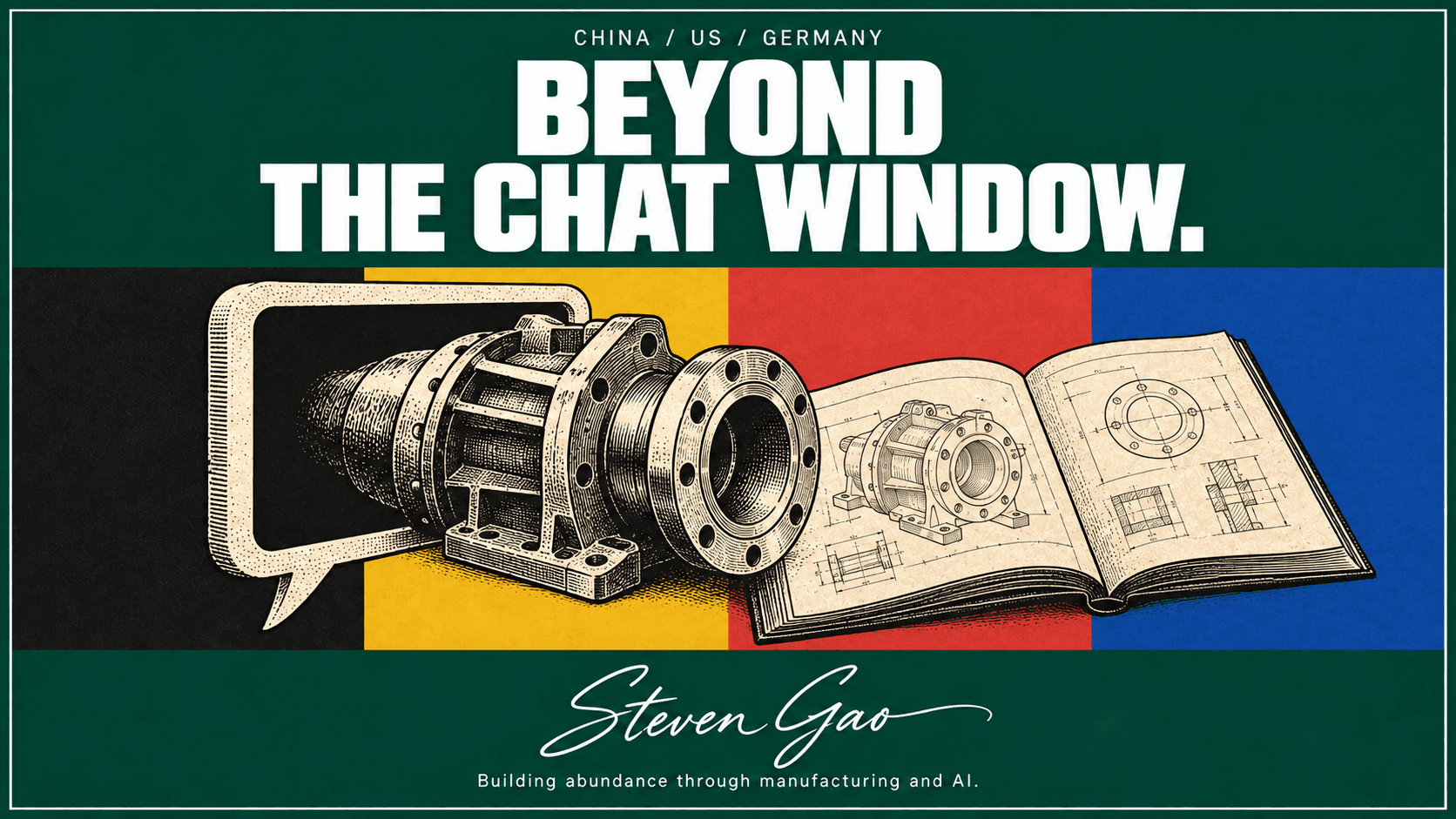
In May 2023, I tried to understand what ChatGPT and large language models could mean for manufacturing. The easiest way to explore the question was to talk to the model itself. The raw conversation was long, repetitive and sometimes confidently generic. The useful part was the set of questions it opened.
Looking back, I think the early excitement was justified. The mistake was to imagine that the consumer chat experience could simply be placed inside a factory and become industrial intelligence.
What I saw early
Language models could make technical knowledge easier to access. An engineer might search manuals without knowing the exact document structure, summarise a fault history, draft a work instruction or translate between the language of production, quality and software. This was a meaningful change because factories already had enormous amounts of information that people could not use efficiently.
I also expected the interface to change. Instead of learning the navigation and data model of every application, a user could express an intention in natural language and let software assemble the relevant context.
What the first wave underestimated
A model that can discuss maintenance is not a maintenance system. It does not automatically know which asset, revision or operating condition the user means. It may not have permission to see the relevant data. It may produce an answer that sounds technically plausible but violates a local safety rule.
The integration burden did not disappear. It moved. We still had to connect the model to trustworthy context, deterministic calculations, plant systems and human approval. We also had to make uncertainty visible, which conversational interfaces are not naturally designed to do.
The breakthrough was natural-language access to knowledge. The product challenge was turning that access into accountable work.
Three layers of value
- Knowledge interface: find, compare and explain existing industrial information.
- Engineering copilot: support diagnosis, planning and documentation while keeping an expert in control.
- Operational agent: coordinate tools and workflows under explicit permissions, checks and escalation rules.
The first layer was available quickly. The second required domain grounding. The third demanded a real product architecture and an organisation willing to define responsibility. Treating all three as ‘a chatbot’ hid the most important work.
What I believe now
Large models will become a standard component of manufacturing systems, but they will often be invisible. The operator will care that a problem is explained correctly and the next action is safe. The engineer will care that evidence is traceable. The business will care that the workflow improves an outcome.
The 2023 question was whether ChatGPT belonged in manufacturing. The better question today is which industrial decisions can be made faster and better when language models are combined with process knowledge, tools and accountable people.