Imagine buying a German company that has been around for 50 years.
It has loyal customers, experienced employees and a product people actually need. It makes money. The owner is ready to retire, and the children have chosen different careers.
If you have ever spent years building a startup, this sounds almost too good to be true.
Someone else has already done the difficult part. You can take over, modernize the business and build from there.
I understand the appeal. But there is one question I would want answered before getting excited:
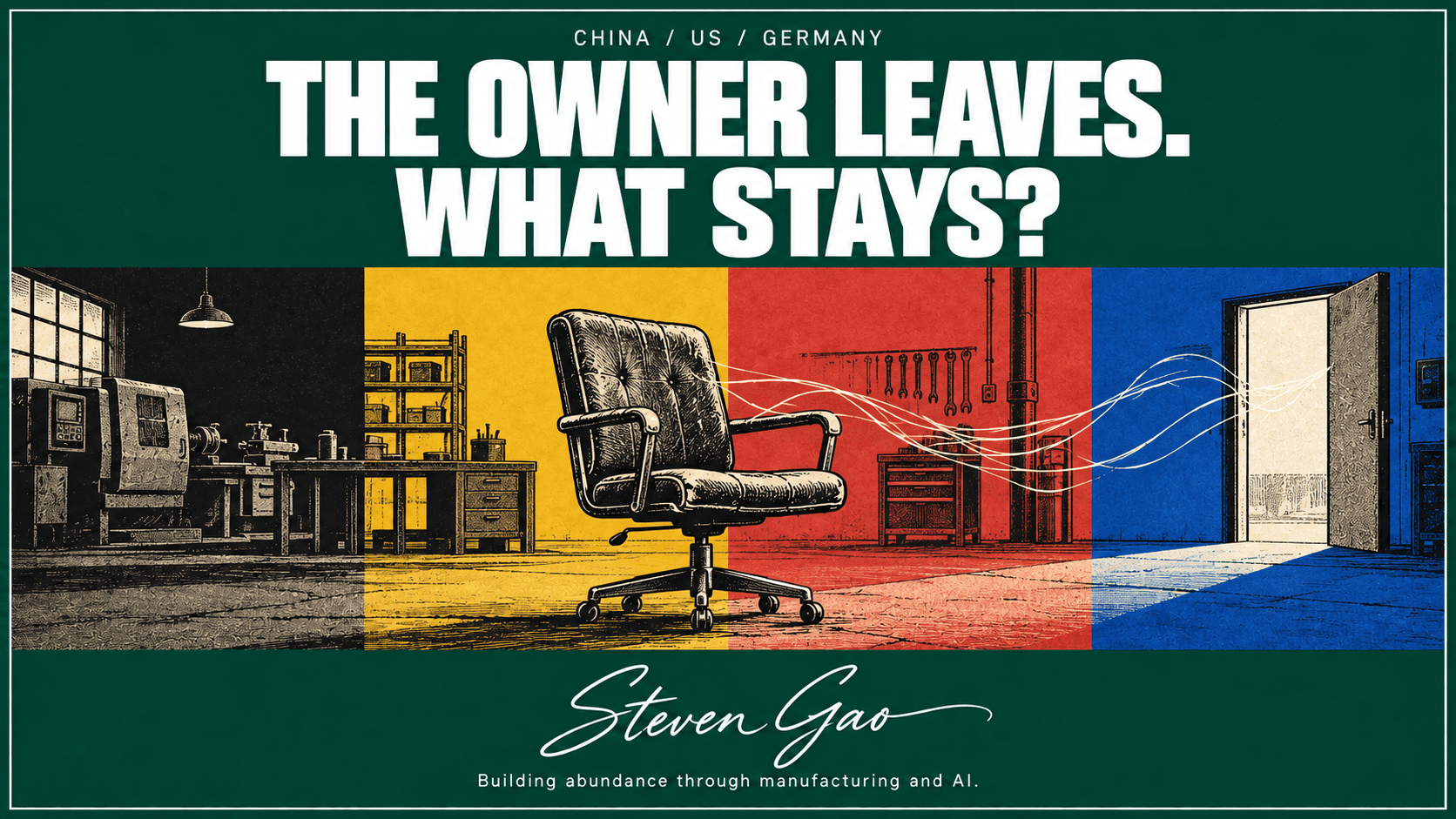
How much of this company will still work when the owner stops coming in?
That question sits at the centre of Germany’s succession problem.
KfW’s 2025 survey found that 57% of German SME owners were 55 or older, compared with 20% roughly two decades earlier. It estimated around 109,000 planned successions per year through 2029, alongside approximately 114,000 potential closures annually as owners step away. These are owners’ intentions, not completed transfers or inevitable closures.
Those numbers suggest a large opening for entrepreneurs. They do not tell us how many good, transferable businesses are available to buy.
The SME population includes tiny businesses and solo operators. And KfW actually found that near-term succession plans were relatively well advanced, with fewer unwanted closures expected among owners actively seeking successors. The picture is more complicated than “nobody wants these companies.”
What worries me is the gap between a business that works for its current owner and a business that will work for its next one.
Take a hypothetical manufacturer with €20 million in revenue and €2 million in EBITDA.
On paper, it looks like an established business with room for improvement.
Then you spend time inside it.
The owner handles the most important customers. He approves difficult quotations because nobody else is confident about the margins. When production gets stuck, people call him. A senior engineer knows why certain parts are made differently from the drawings.
The business has an organization chart. But the actual decision-making still runs through three people.
Now imagine two of them retiring within eighteen months of the acquisition.
You have bought the company. You still need to build the organization that can run it.
This is where the financial picture can change quickly.
If the founder has been doing three jobs, replacing him costs money. If machinery replacement has been postponed, that costs money too. So do a stronger management team, better systems and the working capital needed to keep customers supplied.
EBITDA is a useful starting point. It is not the amount a new owner can safely take home.
I would be particularly careful with an acquisition that needs everything to go right: customers stay, key employees stay, financing remains comfortable, and modernization delivers savings immediately.
A transition needs room for surprises. A business can survive for decades and still be fragile during a change of ownership.
There is also a human side that acquisition discussions tend to rush past.
A founder may have spent forty years earning the trust of employees and customers. A buyer arrives with a presentation explaining what needs to change.
The buyer may be right about the changes. That does not mean people are ready to follow.
Someone who has worked there for twenty-five years is likely to wonder whether the new owner understands the product, respects the team and intends to stay.
That matters commercially. If experienced employees leave before their knowledge has been passed on, part of the company’s value leaves with them.
This is also why I would be cautious about using AI as the answer to every succession problem.
There are useful places to start: finding previous quotations, connecting quality reports to drawing revisions, helping newer employees locate relevant technical documents.
But uploading a folder does not capture everything an experienced engineer knows.
Someone still has to explain why a workaround exists, when it is safe to use and when it is not. Someone needs to check that the system’s answer is correct.
If I were taking over one of these businesses, I would want that work to begin while the people who understand it are still there—and still willing to help.
My pessimistic view is that Germany’s succession opportunity may be much easier to describe than to execute.
Finding a business is one challenge. Finding someone willing to move there, manage it every day and spend years earning the right to change it is another.
For a founder, that makes this a personal decision as much as a financial one.
Would I still want to run this company if the AI improvements took twice as long as expected? If international expansion stalled? If the first year was mostly about retaining customers and fixing basic processes?
If the answer is no, an attractive purchase price probably will not make it the right business.
There will be good opportunities in this transition. I suspect they will reward people who enjoy the daily work of running a company more than people who enjoy the idea of buying one.
Before asking, “What could this company become?”, I would spend a lot of time asking, “What keeps it working today?”
The answer may determine whether there is anything left to transform.
References