I keep coming back to a question about Germany:
What if some of the best opportunities for the next generation of entrepreneurs are inside companies the previous generation has already built?
When we talk about entrepreneurship, we usually start with an idea. Then come the product, the first customers, the team and the long search for a business that works.
There is another starting point.
An established company. A useful product. Customers who already pay. And an owner who would like to retire.
KfW estimates that roughly 545,000 German SMEs intend to arrange a succession by the end of 2029. That includes family transfers and other forms of succession; it is not a list of half a million businesses available for acquisition. Still, it gives a sense of how much ownership could change over a few years.
As a founder, I find the possibilities behind that number interesting.
Imagine a German industrial company with eighty employees, €20 million in revenue and €2 million in EBITDA. This is an illustrative example, not a specific acquisition target.
It has spent thirty years making something its customers depend on. The team understands the engineering. The products have the necessary approvals. Buyers know the company and trust it to deliver.
The owner is sixty-seven and has no successor.
Sales still depend heavily on him. Quotations take too long. Useful engineering information is scattered across folders and email threads. The company has barely explored markets beyond its existing customer base.
I can see why an entrepreneur would look at that business and think: there is another chapter here.
My first reaction is to describe it as a startup that found product-market fit in 1998.
Of course, product-market fit has to be maintained. A long history does not protect a company from changing technology or customers who no longer need its product.
But if the demand is still there, the starting position is powerful.
You already have access to customers. You can observe real workflows. You have experienced employees who can tell you where things break. And you can test improvements inside an operating business.
Anyone who has tried selling technology into industry knows how valuable that access can be.
A new software company might spend months trying to get a manufacturer to share data, explain a process and agree to a pilot. An entrepreneur running the manufacturer can work on those problems directly with the team.
That is where the connection with AI becomes interesting to me.
Take quotations.
Perhaps an experienced employee spends hours searching for similar jobs, comparing specifications and checking what went wrong last time. A useful first project could bring those records together, show the relevant sources and help prepare a draft for review.
Or take a recurring quality problem.
The information may already exist across inspection reports, customer complaints and drawing revisions. Helping an engineer find and compare those records could save time and improve the investigation.
Neither project requires turning the whole factory upside down.
Both begin with a task people already do, information the company already has and an employee who can judge whether the output is useful.
I would want to measure things such as quotation turnaround, time spent finding information, rework and how quickly a new employee can handle a task independently.
Those improvements are less dramatic than announcing an “AI-native factory.” They are also much easier to connect to the economics of the business.
There is a sensible order to the work.
First, keep the company working through the handover. Make sure customers know whom to call and employees know who can make decisions.
Then spend time with the people who understand the difficult cases. Document their reasoning, connect it to actual records and make it usable by others.
Once that foundation is stronger, expand what the business can do: respond to more enquiries, serve new markets, develop additional services or take on work it previously lacked the capacity to handle.
For me, that sequence is what makes acquisition entrepreneurship attractive. Each improvement can support the next.
It also gives international entrepreneurs something concrete to contribute.
Someone with experience in China’s industrial supply chains, for example, might help develop Asian sales or improve sourcing. A founder with software experience might help the team reduce administrative work. An operator with strong commercial skills might build a sales process that no longer depends on the founder.
But those contributions have to fit the company.
Buying a German business does not automatically give you lasting customer trust. You still have to deliver the quality, service and engineering capability that customers came for.
I would want the existing team to feel that the new owner understood what they had built—and could help them do more with it.
That is also how I would choose a target.
I would look for continuing customer demand, people willing to stay through the transition and a few specific constraints I knew how to address.
An outdated website would not be enough. Neither would an old ERP. There needs to be a valuable business underneath, and a credible reason why I could help it improve.
The attraction is that entrepreneurship can begin with something substantial already in place.
You do not have to invent every relationship, recruit every expert or earn the first decade of trust from scratch. You do have to take responsibility for what happens next.
I still believe in building new companies. But I think we give too little attention to founders who choose to take over existing ones.
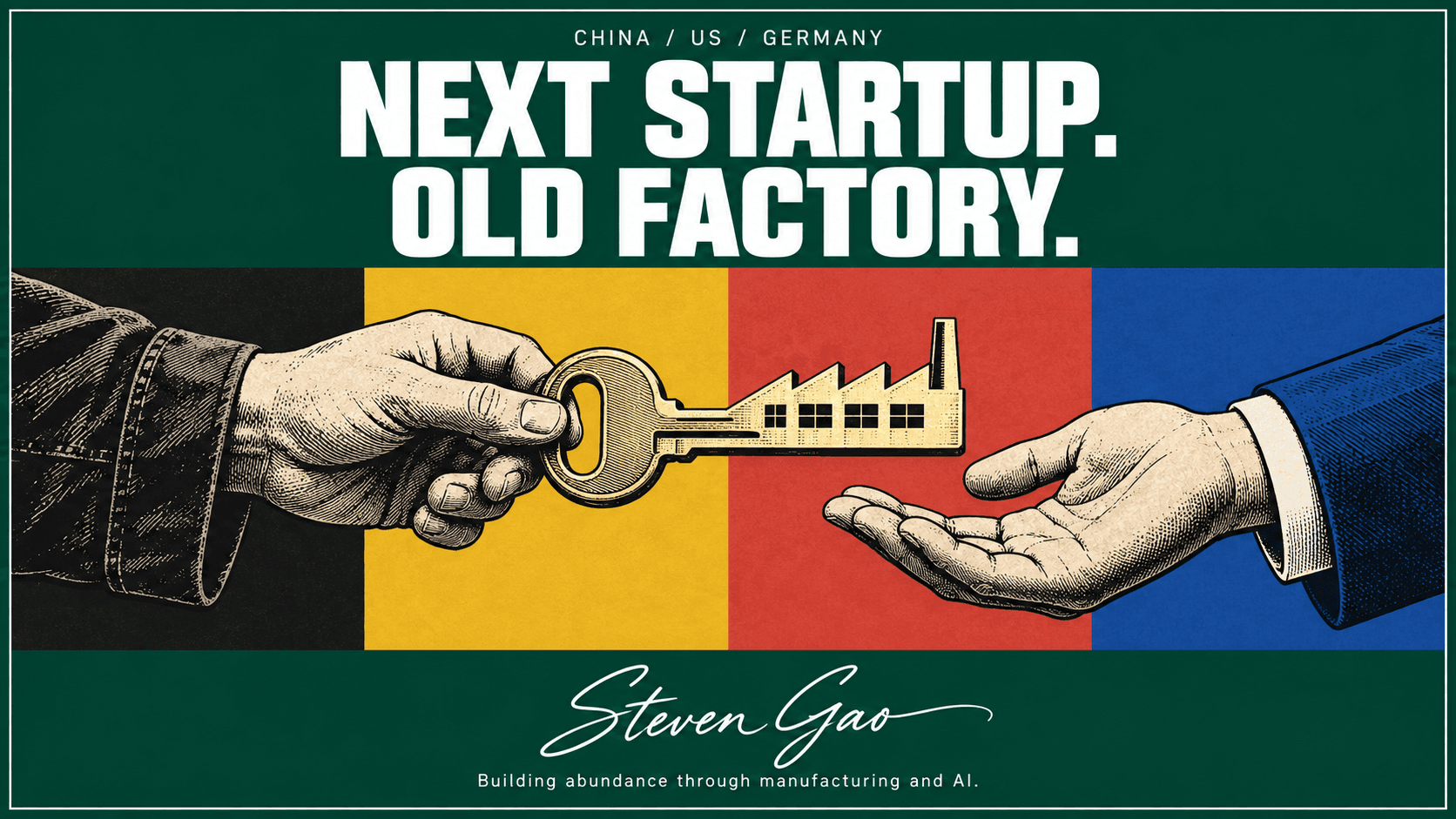
A thirty-five-year-old taking the keys to a factory founded in 1978 could have decades of company building ahead of them.
That feels like a serious entrepreneurial opportunity to me.
And one Germany has good reason to care about.
References