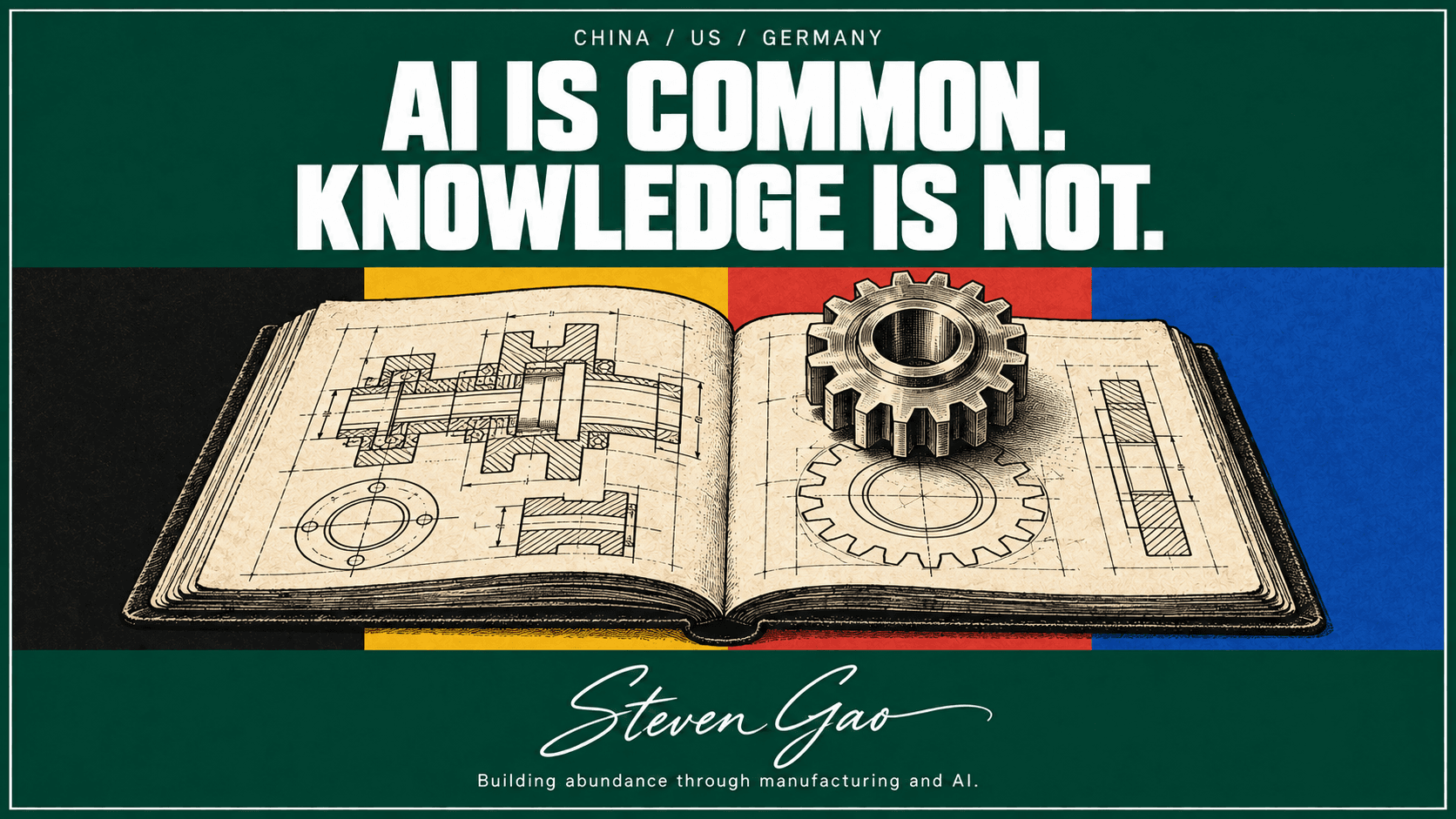
After attending a recent discussion at #TECH 2026 on Industrial AI, manufacturing, and the future of European industry, one thought kept coming back to me:
We are talking too much about AI.
And not enough about outcomes.
The discussion covered topics ranging from manufacturing, wind energy, industrial data, foundation models, Europe’s competitiveness, and China’s industrial transformation. While the speakers came from different backgrounds, a common theme emerged:
The companies that win the AI era will not be those with the best chatbot.
They will be the ones that can turn industrial knowledge into measurable outcomes.
Insight #1: Nobody Buys AI
One speaker made a simple but powerful point:
Customers do not buy AI.
They buy productivity.
They buy quality.
They buy speed.
They buy better decisions.
For a wind turbine operator, the KPI is not how sophisticated the AI model is.
The KPI is Annual Energy Production (AEP).
For a factory, the KPI is not how many agents are deployed.
The KPI is throughput, yield, OEE, engineering efficiency, and cost.
This is where many AI discussions go wrong.
We treat AI as a product.
In reality, AI is becoming infrastructure.
Just like electricity, databases, or cloud computing.
The value is created by the outcome, not by the technology itself.
Insight #2: Industrial AI Is Not Trained on the Internet
Large language models were built on internet-scale data.
Industrial AI is different.
Manufacturing knowledge does not live on public websites.
It lives inside:
- CAD files
- BOMs
- Process plans
- Quality reports
- Simulation models
- Machine data
- Sensor streams
- Engineering decisions
There is no manufacturing equivalent of Common Crawl.
Every industrial company owns a unique dataset that reflects decades of accumulated engineering experience.
This means industrial data is becoming one of the most valuable strategic assets in the AI era.
Not because it is large.
But it is difficult to replicate.
Insight #3: China’s AI Journey Started With Automation, Not AI
One of the most interesting discussions focused on China’s industrial development.
The sequence was remarkably clear:
Automation
→ Data
→ Machine Learning
→ Generative AI
→ Physical AI
Many observers focus only on the last step.
But the foundation was built years earlier.
Factories became automated.
Processes became digital.
Massive datasets were generated.
Only then did AI become possible.
This is an important lesson for both Europe and North America.
AI is not a shortcut.
It is a multiplier of existing industrial capabilities.
Without automation and data generation, there is no scalable industrial AI.
Insight #4: Data Alone Is Not Enough
Several speakers emphasized that most AI projects fail for the same reason.
Organizations focus on technology before asking three critical questions:
- What outcome are we trying to achieve?
- Do we have the necessary data?
- Are people prepared to work differently?
If any one of these is missing, the project struggles.
The challenge is rarely the model.
The challenge is aligning outcomes, data, and organizational adoption.
Successful AI programs are ultimately change management programs.
Insight #5: The Future Is Industrial Foundation Models
Another fascinating topic was whether industrial companies should build their own models.
The answer is not necessarily to train another GPT.
The real opportunity lies in combining:
- Industrial Knowledge
- Domain-Specific Data
- Foundation Models
This is where manufacturing companies have a natural advantage.
They possess:
- Proprietary geometries
- Material properties
- Process knowledge
- Simulation results
- Operational history
These assets are extremely difficult for outsiders to reproduce.
Over time, we may see industrial foundation models emerge around specific sectors such as automotive, energy, aerospace, chemicals, and electronics manufacturing.
Insight #6: Europe Is Sitting on a Hidden Treasure
Perhaps the strongest message for Europe was this:
Europe does not have a data shortage.
Europe has a data utilization problem.
Across manufacturing companies, research institutes, and engineering organizations, enormous amounts of high-quality industrial data already exist.
Much of it remains:
- Undocumented
- Unstructured
- Disconnected
- Underutilized
The opportunity is not creating more data.
The opportunity is unlocking the value of existing industrial knowledge.
Europe’s competitive advantage has always been engineering excellence.
The next challenge is converting that engineering excellence into AI-ready knowledge systems.
Insight #7: The Future Is Not AI-First. It Is Outcome-First.
The biggest misconception in the market today is treating AI as the destination.
AI is not the destination.
AI is a tool.
The destination is better products, faster innovation, stronger manufacturing systems, and more competitive industries.
The companies that win will not be the ones asking:
“What AI model should we use?”
They will be asking:
“How do we engineer better outcomes?”
That shift—from AI-first thinking to outcome-first thinking—may ultimately define the next generation of industrial leaders.
Final Thought
The industrial AI race will not be won by whoever builds the largest model.
It will be won by whoever best combines:
- Industrial Knowledge
- Data
- Engineering Expertise
- Organizational Execution
The future of manufacturing AI is not about replacing engineers.
It is about amplifying engineering knowledge at scale.
And that is a much bigger opportunity than AI alone.
Join the discussion on LinkedIn ↗